Chandrayaan-I - ISRO's prestigious mission to moon plan

Collapse
X
 
  • Filter
  • Time
  • Show
Clear All
new posts
  • sivaadarsh
    • Jul 2007
    • 373

    Chandrayaan-I - ISRO's prestigious mission to moon plan

    Chandrayaan-1 is a scientific investigation ? by spacecraft ? of the Moon. The name Chandrayaan means ?Chandra- Moon , Yaan-vehicle?, ?in Indian languages (Sanskrit and Hindi) , ? the lunar spacecraft. Chandrayaan-1 is the first Indian planetary science and exploration mission.

    Chandrayaan-1 will be launched in early 2008 from Satish Dhawan Space Centre at Sriharikota (SHAR), India.

    It will take about 5? days for Chandrayaan-1 to get to the Moon.

    Chandrayaan-1 spacecraft will be in a 100 km polar orbit around the Moon.

    Scientific Objectives

    The Chandrayaan-1 mission is aimed at high-resolution remote sensing of the moon in visible, near infrared(NIR), low energy X-rays and high-energy X-ray regions. Specifically the objectives will be to prepare a three-dimensional atlas (with a high spatial and altitude resolution of 5-10m) of both near and far side of the moon.

    To conduct chemical and mineralogical mapping of the entire lunar surface for distribution of elements such as Magnesium, Aluminum, Silicon, Calcium, Iron and Titanium with a spatial resolution of about 25 km and high atomic number elements such as Radon, Uranium & Thorium with a spatial resolution of about 20 km.


    Simultaneous photo geological and chemical mapping will enable identification of different geological units, which will test the early evolutionary history of the moon and help in determining the nature and stratigraphy of the lunar crust.

    Mission Objectives

    To realise the mission goal of harnessing the science payloads, lunar craft and the launch vehicle with suitable ground support systems including DSN station.

    To realise the integration and testing, launching and achieving lunar polar orbit of about 100 km, in-orbit operation of experiments, communication/ telecommand, telemetry data reception, quick look data and archival for scientific utilization by identified group of scientists.


    Read more about:
    Mission sequence

    Reposted(Simultaneously) from blog4nimhans (site exclusive for ex/NIMHANSians alike) W.P.F: Forum Administrator
    (blog4nimhans)
    Last edited by sivaadarsh; 23 October 2007, 01:20. Reason: inserting hyperlink
    Regards.

    Siva Adarsh
  • tharadas
    • Sep 2007
    • 25

    #2
    Very informative....

    Comment

    • sivaadarsh
      • Jul 2007
      • 373

      #3
      Mission Sequence
      The spacecraft would be launched by PSLV-XL in a highly elliptical transfer orbit with perigee of about 240 km and an apogee of about 24,000 km. Later, the spacecraft would be raised to moon rendezvous orbit by multiple in-plane perigee maneuvers. These maneuvers would help to achieve the required 3,86,000 km apogee of the Lunar Transfer Trajectory (LTT).

      After a quick estimate of the achieved LTT a mid-course correction will be imparted at the earliest opportunity. The spacecraft coasts for about five and a half days in this trajectory prior to the lunar encounter. The major maneuver of the mission, called Lunar Orbit Insertion (LOI) that leads to lunar capture, would be carried out at the peri-selene (nearest point in lunar orbit) leading to successful lunar capture in a polar, near circular 1000 km-altitude orbit.

      After successful capture and health checks, the altitude is planned to be lowered through a series of in-plane corrections to achieve the target altitude of 100 km circular polar orbit.


      MIP (Moon Impact Probe) Separation


      NB: For animated view of the same, visit ISRO website. Sorry couldnt post the animated view here as I could not upload .swf files to photobucket(available only for pro members)


      The Spacecraft

      Spacecraft for lunar mission is :
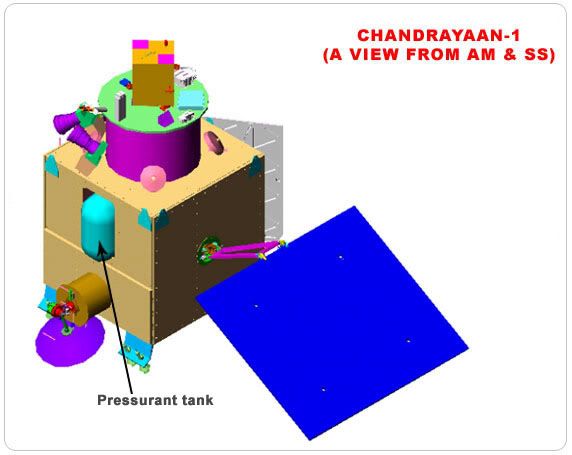
      1. Cuboid in shape of approximately 1.50 m side.
      2. Weighing 1304 kg at launch and 590 kg at lunar orbit.
      3. Accommodates eleven science payloads.
      4. 3-axis stabilized spacecraft using two star sensors, gyros and four reaction wheels.
      5. The power generation would be through a canted single-sided solar array to provide required power during all phases of the mission. This deployable solar array consisting of a single panel generates 700W of peak power. Solar array along with yoke would be stowed on the south deck of the spacecraft in the launch phase. During eclipse spacecraft will be powered by Lithium ion (Li-Ion) batteries.
      6. After deployment the solar panel plane is canted by 30? to the spacecraft pitch axis.
      7. The spacecraft employs a X-band, 0.7m diameter parabolic antenna for payload data transmission. The antenna employs a dual gimbal mechanism to track the earth station when the spacecraft is in lunar orbit.
      8. The spacecraft uses a bipropellant integrated propulsion system to reach lunar orbit as well as orbit and attitude maintenance while orbiting the moon.
      9. The propulsion system carries required propellant for a mission life of 2 years, with adequate margin.
      10. The Telemetry, Tracking & Command (TTC) communication is in S-band frequency.
      11. The scientific payload data transmission is in X-band frequency.
      12. The spacecraft has three Solid State Recorders (SSRs) on board to record data from various payloads.
      • SSR-1 will store science payload data and has capability of storing 32Gb data.
      • SSR-2 will store science payload data along with spacecraft attitude information (gyro and star sensor), satellite house keeping and other auxiliary data. The storing capacity of SSR-2 is 8Gb.
      • M3 (Moon Mineralogy Mapper) payload has an independent SSR with 10Gb capacity.


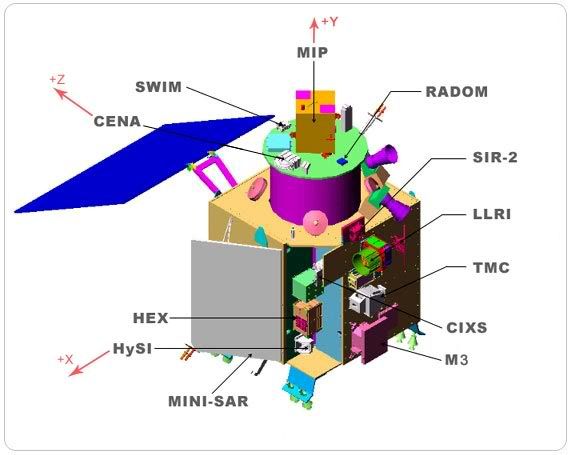
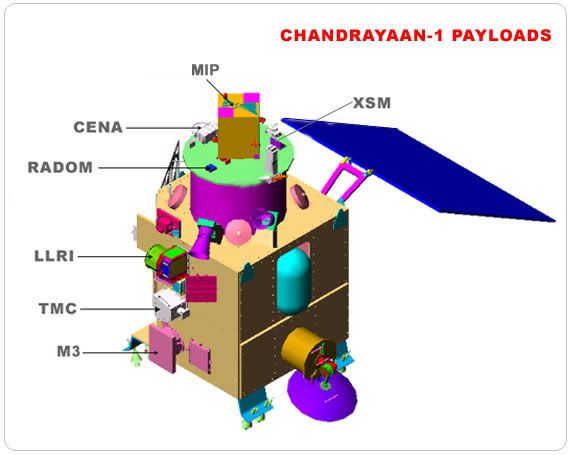
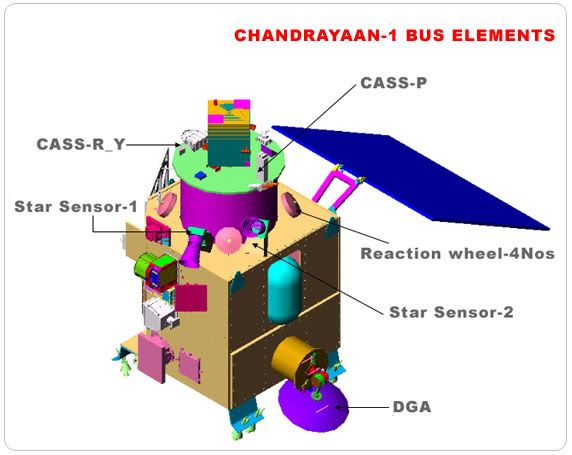
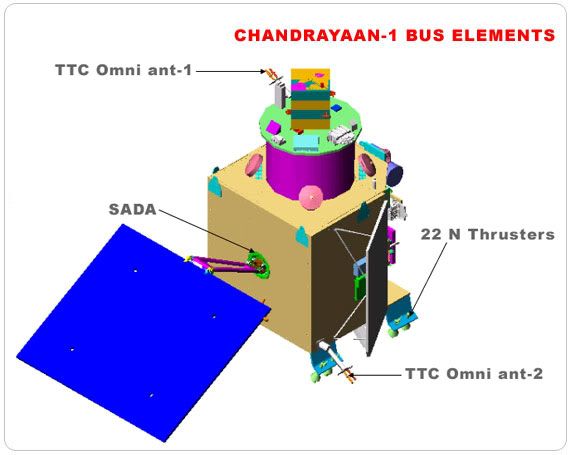
      Presented below are a graphical view of the spacecraft from various angles displaying its various scientific payloads. (Click on the images for an enlarged view)
      View 1:...............................View 2:...............................View 3:


      View 4:...............................View 5:...............................


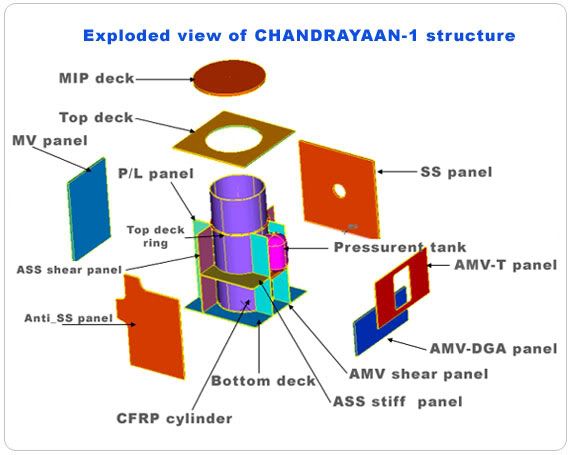
      A fully blown out view of the spacecraft:


      GROUND SEGMENT FOR CHANDRAYAAN-1 MISSION

      Ground Segment for Chandrayaan-1 comprises three major elements viz. Deep Space Station (DSN), Spacecraft Control Center (SCC) and Indian Space Science Data Center (ISSDC).

      This trio of ground facility ensures the success of the mission by providing to and fro conduit of communication, securing good health of the spacecraft, maintaining the orbit and attitude to the requirements of the mission and conducting payload operations.

      The ground segment is also responsible for making the science data available for the Technologists / Scientists along with auxiliary information, in addition to storage of payload and spacecraft data.


      Scientific Payloads (Up next)
      Regards.

      Siva Adarsh

      Comment

      • sparrow
        • Dec 2006
        • 3974

        #4
        hmmm u rock!! this was a gud one
        Never regret a day in your life. Good days give you happiness; bad days give you experiences; both are essential to life-----------------------------------------------------------------------------

        Comment

        • ~IronMan~
          Admin
          • Nov 2006
          • 21300

          #5
          it has been launched today successfully...proud of India
          DONATE & SUPPORT US


          Comment

          • Fernandez
            • Oct 2008
            • 28

            #6
            Wow man, that was informational. Launch was a great success. it carries many other satlites too

            Comment

            • boy ax
              • Oct 2009
              • 166

              #7
              good one ketto, thanks for it

              Comment

              • anaamikaa
                • May 2012
                • 42

                #8
                Re: Chandrayaan-I - ISRO's prestigious mission to moon plan

                indiakkaar chandranil ethiya pattu

                Comment

                Working...
                X